
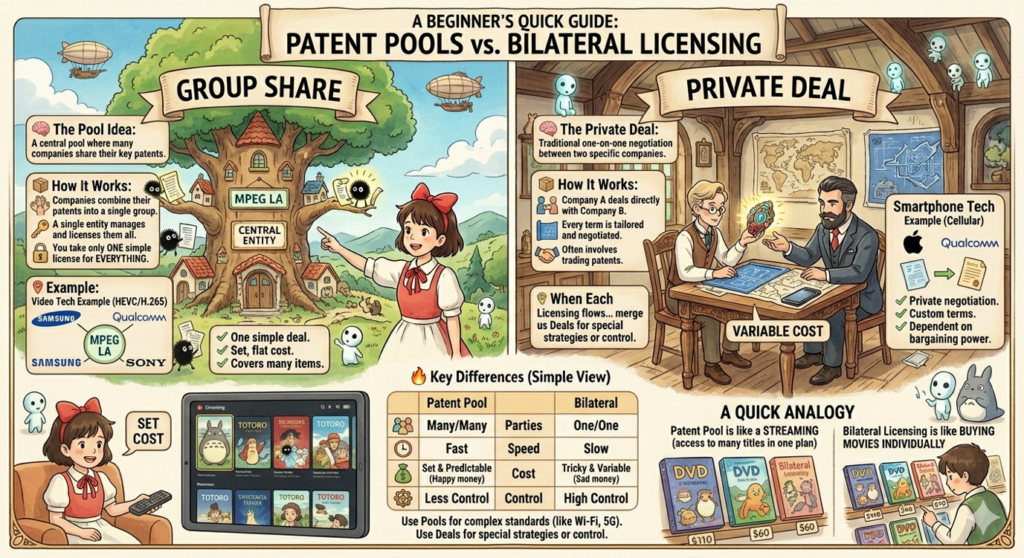
In today’s innovation-driven industries especially telecommunications, consumer electronics, and software companies rarely rely on a single patent. Instead, products often incorporate dozens or even hundreds of patented technologies owned by different entities. This creates a fundamental challenge: how do companies efficiently access all the rights they need?
Two dominant models have emerged to solve this problem: patent pools and bilateral licensing. While your reference image captures the intuition as “group sharing” versus “private deals,” the real-world dynamics are richer and more strategic.
Understanding Patent Pools: Collective Access to Innovation
A patent pool is a collaborative arrangement in which multiple patent owners aggregate their patents and license them as a single package. This model is particularly common in industries built on technical standards, such as video compression (H.264, H.265), Wi-Fi, and 5G.
Organizations like MPEG LA act as intermediaries, managing licensing on behalf of contributors such as Samsung, Sony, and Qualcomm.
How It Works
• Instead of negotiating separately with each patent holder, a company can:
• Obtain a single license from the pool
• Pay a standardized royalty fee
• Gain access to a broad portfolio of patents
This model addresses what is often called the “patent thicket” problem, where overlapping patent rights make individual negotiations impractical.
Why It Matters
Patent pools are designed for efficiency and scalability. They:
• Reduce transaction costs
• Accelerate market entry
• Provide predictable licensing terms
However, they come with trade-offs. Companies have less flexibility in negotiating terms, and not all relevant patents may be included in a given pool.
Bilateral Licensing: Strategic One-to-One Agreements
In contrast, bilateral licensing refers to direct agreements between two parties. Here, companies negotiate terms privately, tailoring the deal to their specific needs and bargaining positions.
A well-known example is the licensing relationship between Apple and Qualcomm, where Apple pays royalties for access to Qualcomm’s cellular technology patents.
How It Works
• Two companies negotiate directly
• Terms are customized and confidential
• Agreements may include:
• Royalty payments
• Cross-licensing (mutual exchange of patent rights)
Why It Matters
Bilateral licensing offers maximum flexibility and strategic control. Companies can:
• Negotiate better pricing
• Secure competitive advantages
• Structure deals based on long-term partnerships
But this flexibility comes at a cost. Negotiations can be time-consuming, expensive, and prone to disputes, especially when valuable patents are involved.
Comparing the Two Models
At their core, patent pools and bilateral licensing represent two different philosophies:
Patent Pools prioritize efficiency and standardization
Bilateral Licensing prioritizes control and customization